
Abstract: What Comes After Decoding Text
Speech brain–computer interfaces connect neural activity during attempted speech to text, voice, or other outputs, providing an important research direction for assistive communication. However, a low error rate and rapid output on a particular vocabulary do not, by themselves, establish that real communication is fluent, controllable, and stable over the long term. This review connects two studies of high-performance speech neuroprostheses, disentangles neural information, language priors, latency, and correction burden, and uses transparent analytical models to discuss how experimental metrics can translate into real communication outcomes.[1] A high-performance speech neuroprosthesis[2] A high-performance neuroprosthesis for speech decoding
English abstract
Speech neuroprostheses combine neural decoding with language priors and interactive communication. We compare intracortical and cortical-surface demonstrations, derive sentence-error and correction-time examples, and distinguish prompted accuracy from spontaneous, user-controlled communication. The review emphasizes session-held-out testing, latency and participant-specific evidence.
Scope of Evidence from Two Demonstrations
Willett and colleagues and Metzger and colleagues demonstrated advances in speech decoding using different recording and output pathways; the latter also investigated voice and virtual facial output. They provide important evidence under particular participant, training, and task conditions. This review does not present individual results as universal performance for everyone who has lost the ability to speak, nor does it simply rank figures obtained with different vocabularies, prompts, and language models in a clinical league table.[1] A high-performance speech neuroprosthesis[2] A high-performance neuroprosthesis for speech decoding
Neural Evidence and Language Priors
Decoders typically combine the likelihood of neural signals with a language-model prior. The latter can correct common errors, but may also favor more common sentences that are not what the user intended to express. Fluent system output does not automatically establish that every word has equal neural support. Research should compare strengths of language priors and tests involving rare words and meaningless but linguistically valid expressions, while retaining uncertainty. Language assistance and neural decoding make different contributions and should be reported separately rather than showing only the final sentence.作者分析与复核建议 / Author analysis
Defining Word Error Rate
Word error rate is usually calculated by dividing the total number of substitutions, deletions, and insertions by the number of reference words. It is not an independent per-word error probability and can even exceed 100% when insertions are numerous. A measured WER therefore cannot be substituted directly into an independent Bernoulli sentence model. The sentence plot in this review uses an explicitly assumed independent position-error rate solely to explain accumulation in long sentences; it neither fits the original studies nor replaces actual alignment and error-type analysis.作者分析与复核建议 / Author analysis
Different Consequences of the Same Average Error Rate
An error may involve an article, a person's name, a negation, or a critical need, with different consequences for communication. Research needs to analyze error categories and semantic impact while protecting privacy, and allow users to confirm or retract output. Improving language fluency alone may reduce surface errors while changing the intended meaning. The system's goal should be to preserve the speaker's control, rather than treating the most probable language continuation as their actual intention.作者分析与复核建议 / Author analysis
A Long-Sentence Counterexample with Independent Errors
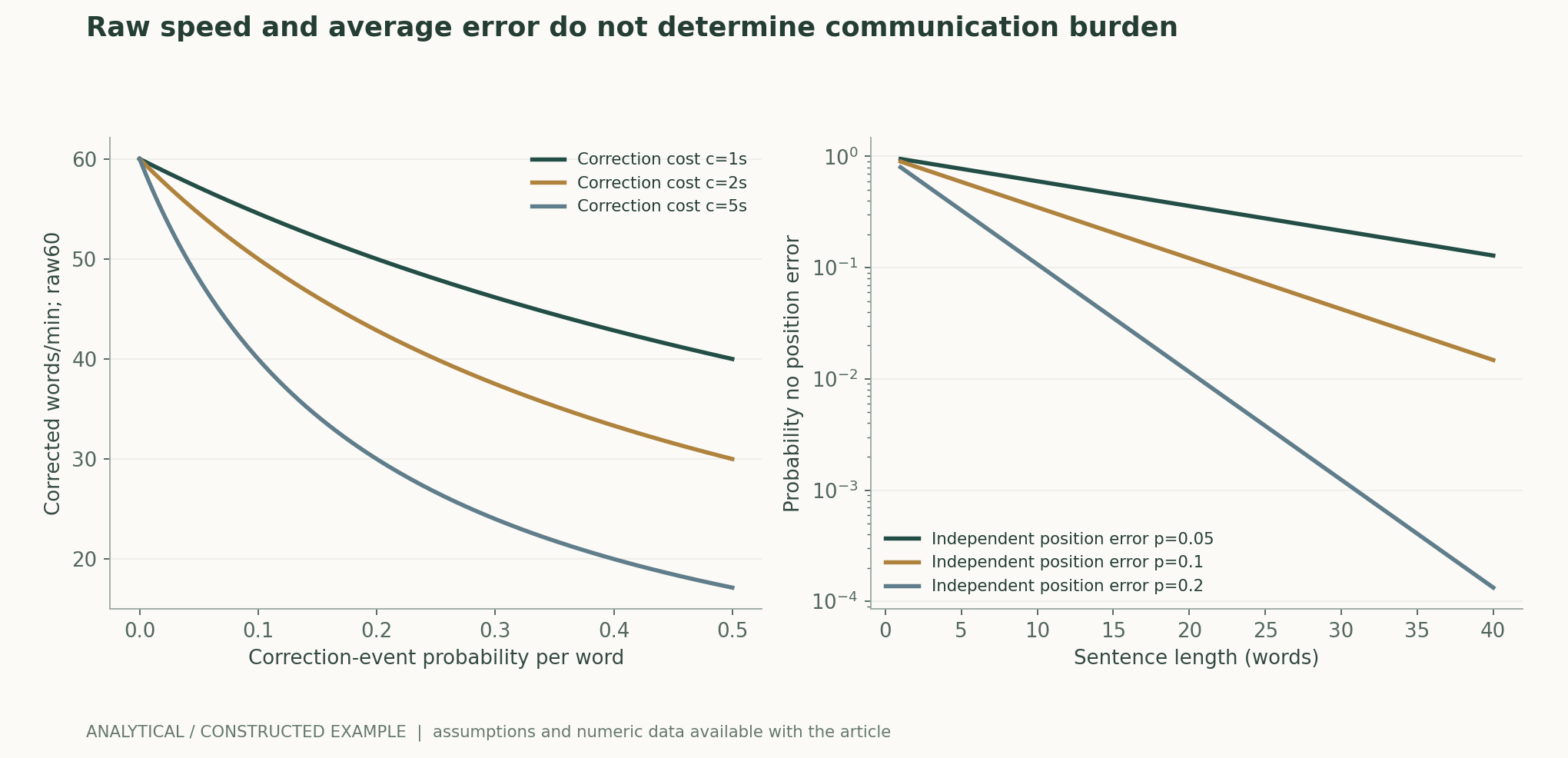
Assuming that each position has a probability of being correct of 1−p and that positions are independent, the probability that a sentence of length L is entirely correct is (1−p) raised to the power L. Even when performance at individual positions is good, the probability of an error-free long sentence may still decline. Real errors involve correlations, insertions, deletions, and language constraints, so this formula is only a minimal counterexample. The plot contains no real neural or patient data; it reminds researchers to report sentence-level, semantic, and interaction-level endpoints as well.作者分析与复核建议 / Author analysis
Correction Time Changes Effective Speed
Assume a raw speed of v, a probability e per word of an event requiring correction, and an additional c seconds per event. The average word rate after complete correction can then be written as 60 divided by the sum of raw time per word and expected correction time. This constructed model shows that faster raw output may be offset by the burden of correction. Real communication also includes selection, confirmation, and pauses, so task completion time should be measured directly rather than treating raw words per minute alone as the final experience.作者分析与复核建议 / Author analysis
Latency Should Be Reported as a Distribution
Average latency may conceal occasional long pauses, which are especially important in real-time conversation. Neural windows, computation, language search, voice synthesis, and network transmission should be distinguished, and the tail of the distribution reported. Streaming output also involves content spoken early that may later need revision; if users cannot retract it, different control problems arise. Research should show the trade-offs among accuracy, latency, and revision strategies, rather than treating the fastest example as typical performance.作者分析与复核建议 / Author analysis
Prompted Sentences and Spontaneous Communication
Attempting to speak known sentences displayed on a screen allows experiments to obtain precise references, but has a different distribution from users' spontaneous communication. Sentence length, vocabulary, pauses, and communicative purposes can all change. Research should clearly specify task type and progressively validate more natural communication under appropriate conditions. Success on prompted tasks is important, but without new evidence it cannot automatically be upgraded to an ability to conduct arbitrary open-ended dialogue.作者分析与复核建议 / Author analysis
Vocabulary and Test Overlap
Limited and open vocabularies entail different levels of difficulty. Training sentence patterns and the distributions of rare words and homophones also affect model performance. If training and testing share many sentences or phrases, language priors may aid re-recognition. Data should be split by sentence family and temporal session, and out-of-vocabulary behavior reported. When an unknown word cannot be output, the system needs an explicit rejection or alternative mechanism; it must not always overwrite it with a common word.作者分析与复核建议 / Author analysis
Session Drift and Long-Term Adaptation
Neural recordings and user strategies may change across days, and model recalibration can also affect evaluation. Research should separate the cross-day performance of frozen models from performance with continual retraining, recording which data each update used. Recovery after retraining does not mean that the original model remained unchanged and stable over the long term; both can have practical value, but their maintenance burdens and evidential implications differ.作者分析与复核建议 / Author analysis
Participants and Experimental Units
Large numbers of sentences, time windows, and electrode channels do not equal large numbers of independent participants. Within-person repetitions can assess stability, but cannot automatically establish effects across populations. Participant, session, and sentence hierarchies should be retained, avoiding excessively narrow intervals created by treating all time windows as independent samples. Participants' disease backgrounds, recording sites, and previous communication methods may also affect results and must not be ignored.作者分析与复核建议 / Author analysis
Rejection and Unintended Activation
Beyond correctly decoding attempts to communicate, a system needs to recognize when there is no intention to communicate. Evaluating only after a known start signal misses unintended activations in everyday use. Output during rest, other movements, and non-target states should be measured independently, and users should be allowed to explicitly start, pause, and confirm. This review discusses research endpoints only and provides no procedures for implantation or individual use.作者分析与复核建议 / Author analysis
Voice and Virtual Facial Output
Natural voices and facial movements may enhance expression, but intelligibility, identity resemblance, and emotional control are distinct goals. Listener transcription accuracy and users' judgments of whether output conveys their intended meaning also require separate evaluation. More fluent generated speech does not imply stronger evidence of neural control. Research should document synthesis models, training sources, and the scope of user authorization, and let speakers decide how their voices and appearances are presented.作者分析与复核建议 / Author analysis
Offline and Online Results
Offline models can use future context or precise segmentation, whereas online systems must produce output within causal time constraints. Presenting the best offline results as real-time capability overlooks window and computation constraints. Information available online should be fixed, actual execution timing recorded, and post-processing corrections distinguished. Computing hardware and network conditions also fall within the scope of reproducibility; algorithmic complexity alone cannot represent actual latency.作者分析与复核建议 / Author analysis
Limits to Interpreting AI Personalization
Personalization can improve performance by using users' vocabulary and habits, but may also make models more dependent on historical language than on current signals. Neural contributions should be compared with and without personalization, and users should be able to modify or clear the relevant data. Model updates need to be traceable; a single instance of feedback should not automatically be treated as a permanent intention. The research goal is to test the balance between assistance and control, rather than assuming that more proactive completion on the user's behalf is always better.作者分析与复核建议 / Author analysis
Privacy and Speaker Agency
Neural signals and communication content are highly personal, and research and demonstrations should respect authorization and data boundaries. Automatically generated errors should not be disseminated as participants' own views without confirmation. Lawful anonymized summaries can be used when sharing verification materials, while retaining sufficient task and error information. This review has not accessed real neural data or personal conversations, nor does it treat a technical demonstration as treatment advice for any individual.作者分析与复核建议 / Author analysis
Analytical Recalculation and Real-World Endpoints
The sentence model can be checked directly using binomial probability, and the correction model can be independently summed from a per-word time ledger. Both assume fixed probabilities or costs and omit real cognitive burden, error correlations, and learning. Their role is to show that different metrics are not automatically interchangeable. Actual research should supplement them with user-involved assessments of task completion, intelligibility, and sense of control, rather than replacing human experience with analytical curves.作者分析与复核建议 / Author analysis
The Next Falsifiable Comparison
If a new decoder lowers WER but increases tail latency or important semantic errors, whether it still improves communication requires direct measurement. Comparisons should prespecify tasks, confirmation mechanisms, and maintenance frequency, and evaluate frozen models on unseen sessions. A genuinely better system should reduce the overall burden of communication within the same information boundaries, while preserving users' ability to choose and correct, rather than merely generating smoother text.作者分析与复核建议 / Author analysis
Conclusion and Research Package
Verifiable materials should include lawful task summaries, session splits, vocabulary, language models, error alignments, latency, updates, and interaction rules. Progress in speech brain–computer interfaces must ultimately yield communication that speakers can reliably control, rather than a record for a single algorithmic metric. Separating and connecting neural evidence, language assistance, and human experience can help important demonstrations advance toward broader applications along a verifiable path.作者分析与复核建议 / Author analysis
Core Equations and Derivations
(1) Total substitutions, deletions, and insertions divided by the reference word count; not an independent position probability.
LaTeX
\mathrm{WER}=(S+D+I)/N(2) An assumed model with explicitly independent position errors, not directly using measured WER.
LaTeX
P(\mathrm{error\!\ free})=(1-p)^L(3) A model with a fixed additional correction cost per word, assuming all errors are eventually corrected.
LaTeX
v_{\rm corrected}=60/(60/v+ec)(4) Neural evidence and language priors; specific decoding architectures may differ.
LaTeX
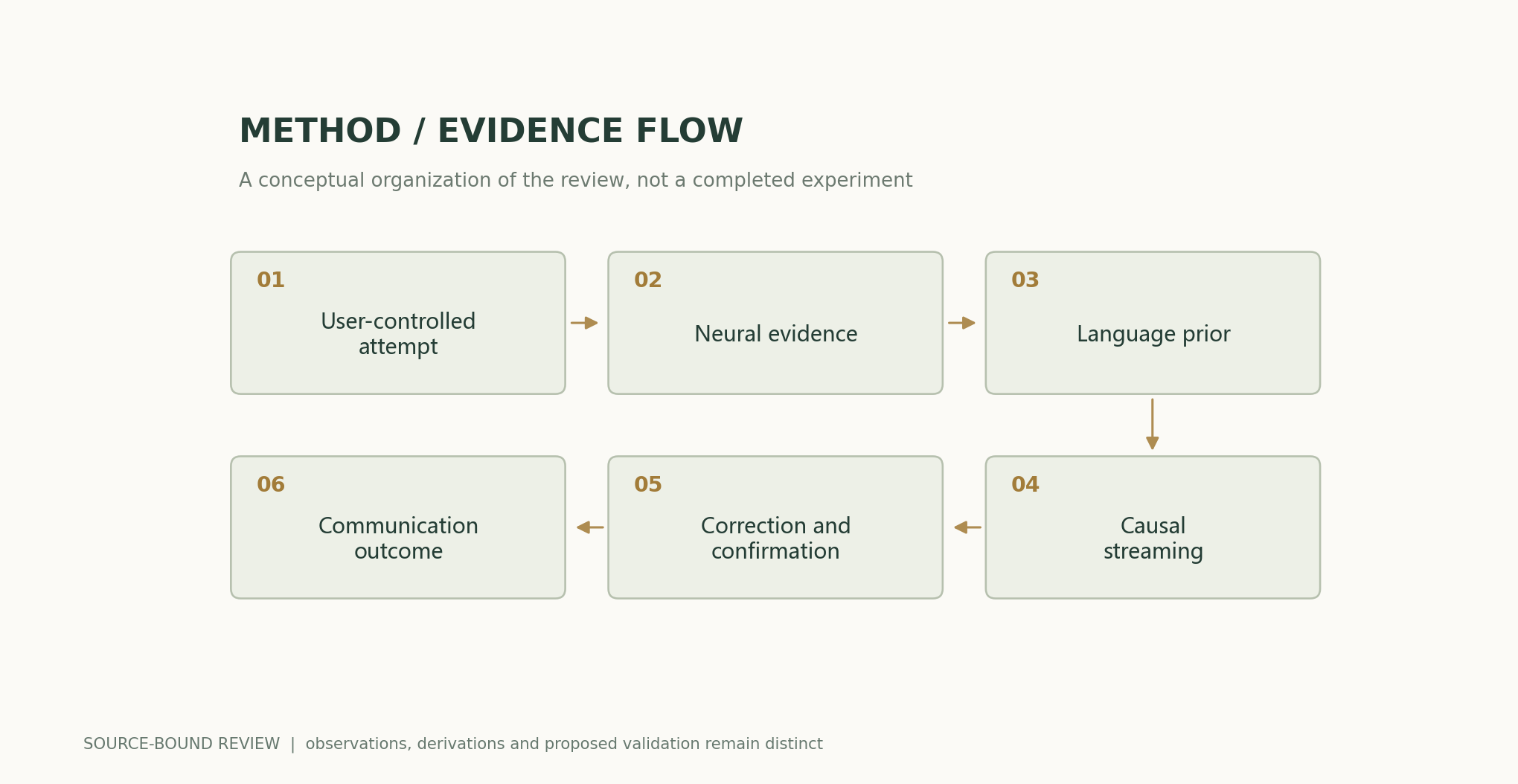
P(w\mid s)\propto P(s\mid w)P_{\rm LM}(w)Methods and Evidence Workflow
Analytical Plots and Numerical Examples
Recalculable Worked Example
At a raw speed of 60 words/min, a correction-event rate of 0.2, and 2 seconds per event, the constructed effective speed is 42.8571 words/min; with an independent position-error rate of 0.2, the probability that all 20 words are correct is 0.8^20=0.0115292.
Comparison of Methods
| Method or measurement basis | What it directly constrains | Evidence still needed |
|---|---|---|
| Word error rate | Editing errors relative to reference text | Semantic and interaction consequences |
| Raw word rate | Output rate | Correction and pauses |
| Sentence correctness | Complete short-sentence outcomes | Open-ended spontaneous expression |
| Mean latency | Typical response | Long tails and unintended activation |
| Cross-day frozen-model testing | Fixed-model stability | Maintenance and continual learning |
| User task performance | Real communication burden | Broader participants and long-term use |
Verification and Experimental Plan
- Fix prompted or spontaneous tasks and primary endpoints.
- Document lawful sessions, vocabulary, and reference texts.
- Separate training and testing by session and sentence pattern.
- Compare neural and language-prior contributions separately.
- Retain error alignments, semantic categories, and rejections.
- Directly measure tail latency and correction and confirmation costs.
- Distinguish frozen-model results from continual-update results.
- Publish lawful summaries, model versions, and user-control rules.
Scope and Limitations
- No new neural recordings, implantations, or clinical trials.
- Results from participants in the original studies cannot represent all users.
- The sentence model does not treat WER as an independent error rate.
- Fixed correction cost is an assumption, not a measurement of experience.
- Fluent generation does not automatically mean correct expression of intent.
Evidence and Scope of the Original Studies
| Original study findings | Scope | Source and location |
|---|---|---|
| Neural signals support large-vocabulary speech decoding in specific participants. | Original task, training, and recording conditions. | A high-performance speech neuroprosthesisAbstract; online decoding |
| Surface recordings combined with text, voice, and virtual facial output. | Original participants and the evaluation scope for different outputs. | A high-performance neuroprosthesis for speech decoding and avatar controlAbstract; multimodal evaluation |
Research Questions Worth Testing
- Does a reduction in WER also reduce the burden of real communication?
- How should cross-day model drift and maintenance be quantified?
- When do language priors improve form while changing the intended meaning?
Mapping Primary Sources to Claims
- A high-performance speech neuroprosthesisFrancis R. Willett, Erin M. Kunz, Chaofei Fan, Donald T. Avansino, Guy H. Wilson, Eun Young Choi, et al. · 2023-08-23Abstract; online text decoding
- A high-performance neuroprosthesis for speech decoding and avatar controlSean L. Metzger, Kaylo T. Littlejohn, Alexander B. Silva, David A. Moses, Margaret P. Seaton, Ran Wang, et al. · 2023-08-23Abstract; speech/text/avatar evaluation
Citation and Manuscript Export
BibTeXRISCSL JSONTXTArticle JSON
Author, Version, and Sources
A sourced research review and original analysis written by Codex (AI). Experiments in the original papers belong to the original research teams; calculations in this review only test the listed equations and explicit assumptions. This site does not yet have independent peer review of this article or records of original model, clinical, or physical experiments.
First publication: an in-depth interdisciplinary scientific evidence feature; preserving the boundaries between section-by-section sources, original study evidence, and the author's analysis.
The conceptual cover was generated by ImageGen. Scientific figures were plotted using the accompanying code and numerical files; captions specify assumptions and measurement bases item by item.
Sources of the Cover and Scientific Figures · Data, Sources, and Assumptions · Python · Recalculable code · Publication and Version History
Source revision: 500575872cce7c4b9c4062a12bb0692eb580c2da