

Abstract
Repeated training samples may alter memorization behavior, while test content entering training may distort generalization evaluation, but these are not the same problem. This article distinguishes exact duplicates, near-duplicate families, semantic overlap, and evaluation leakage, and proposes a workflow that first splits by source family and then audits similarity matches. The analytical figure only shows score mixing under assumed contamination proportions; it makes no accusations about any actual model or dataset.[1] Deduplicating Training Data Makes Language Models Bette[2] Documenting Large Webtext Corpora: A Case Study on the [3] Holistic Evaluation of Language Models
English abstract
Deduplication and benchmark contamination are separate audit questions. We analyze exact matches, near-duplicate families, privacy-related memorization and evaluation leakage. A declared mixture model illustrates how contaminated items can inflate a score without improving uncontaminated accuracy. The figure is not evidence about any existing model or benchmark.
1. Deduplication objectives should be stated first
Reducing repeated training, lowering the risk of memorizing private information, and preventing test contamination may require different definitions of duplication. The same public fact appearing in multiple sources does not necessarily constitute evaluation cheating; a slight rewording of the same question, however, may leak the answer. Deduplication research demonstrates the effects of repeated data on training and evaluation, whereas training-data extraction research focuses on the risk of leakage through memorization. Audit design should specify what is being protected and the unit of judgment, rather than replacing all policies with a single similarity threshold.[1] Deduplicating Training Data Makes Language Models Bette[2] Documenting Large Webtext Corpora: A Case Study on the
2. Exact matching is reliable but has limited coverage
Hashing after normalization can efficiently identify identical texts, but whitespace, formatting, translation, and paraphrasing all change the bytes. Excessive normalization, in turn, may merge code or mathematical problems that are actually different. Original-text hashes, normalization rules, and match locations should be retained so that every deletion can be traced. Approximate matching can extend coverage, but false positives and false negatives must be estimated, especially for questions with the same template but different instances; merely presenting a few successfully detected duplicates is insufficient.[1] Deduplicating Training Data Makes Language Models Bette
3. Splitting by family matters more than randomly splitting individual samples
Paraphrases, translations, and explanations of the same original document, question, or experiment should be treated as a related family. If individual samples are randomly split before exact duplicates are removed, variants may already span training and test sets. Source or generation relationships should be established before splitting, with each entire group assigned to the same side. When family membership cannot be determined, uncertainty flags and human review should be retained, rather than directly labeling samples missed by the detector as uncontaminated. The indexes of retrieval-augmented systems are also data sources that require auditing.[1] Deduplicating Training Data Makes Language Models Bette[3] Holistic Evaluation of Language Models
4. Mixture scores obscure performance on uncontaminated samples
Let the proportion of contaminated samples be c, their accuracy be a1, and the accuracy of other samples be a0; the overall score is their weighted average. Even if a0 remains completely unchanged, increasing c can raise the overall score. The figure in this article fixes a0=0.5 and a1=0.99 to illustrate this identity; it does not estimate any actual contamination rate. Real audits should stratify by match strength and source timing, separately report scores and sample counts before and after exclusion, and acknowledge incomplete detection.[3] Holistic Evaluation of Language Models[1] Deduplicating Training Data Makes Language Models Bette
5. Memorization of private information and answer leakage require different evidence
A model's ability to output training passages does not automatically prove that a particular benchmark score was caused by contamination; test questions appearing in training also does not mean that they necessarily contain private personal information. The former requires controlled extraction and privacy assessment, while the latter requires evidence about timing, provenance, and relationships to answers. This article performs no extraction of actual personal data. Research reports should disclose only the minimum necessary match metadata and excerpts that may lawfully be shown, avoiding the renewed dissemination of sensitive material in an effort to demonstrate risk.[2] Documenting Large Webtext Corpora: A Case Study on the [1] Deduplicating Training Data Makes Language Models Bette
6. A trustworthy audit should allow deletion decisions to be reviewed
Retain detector versions, thresholds, matched families, review conclusions, and reasons for deletion, and inspect samples from both the retained and deleted groups. Evaluation should also use independent samples that are more recent, have controlled provenance, or are private but lawfully authorized, while keeping the evaluation protocol fixed. HELM emphasizes multidimensional evaluation and transparency; accordingly, this task should report both the limitations of contamination detection and differences in metrics. No detected match does not prove the absence of overlap, and a single overall score cannot replace a contamination audit.[3] Holistic Evaluation of Language Models[1] Deduplicating Training Data Makes Language Models Bette
Core equations and derivations
(1) Stratified weighted identity; both A0=0.5 and A1=0.99 in the figure are assumptions, not model measurements.
LaTeX
A_{\mathrm{mix}}=(1-c)A_0+cA_1(2) Represents the difference between the mixture score and A0 only when the stated stratum definitions hold; it cannot be used to infer the actual contamination rate.
LaTeX
\Delta A=c(A_1-A_0)(3) A match detector must estimate false positives and false negatives using human-labeled or controllably injected samples and explain the sampling method.
LaTeX
\mathrm{precision}=\frac{TP}{TP+FP},\qquad\mathrm{recall}=\frac{TP}{TP+FN}Method and evidence workflow
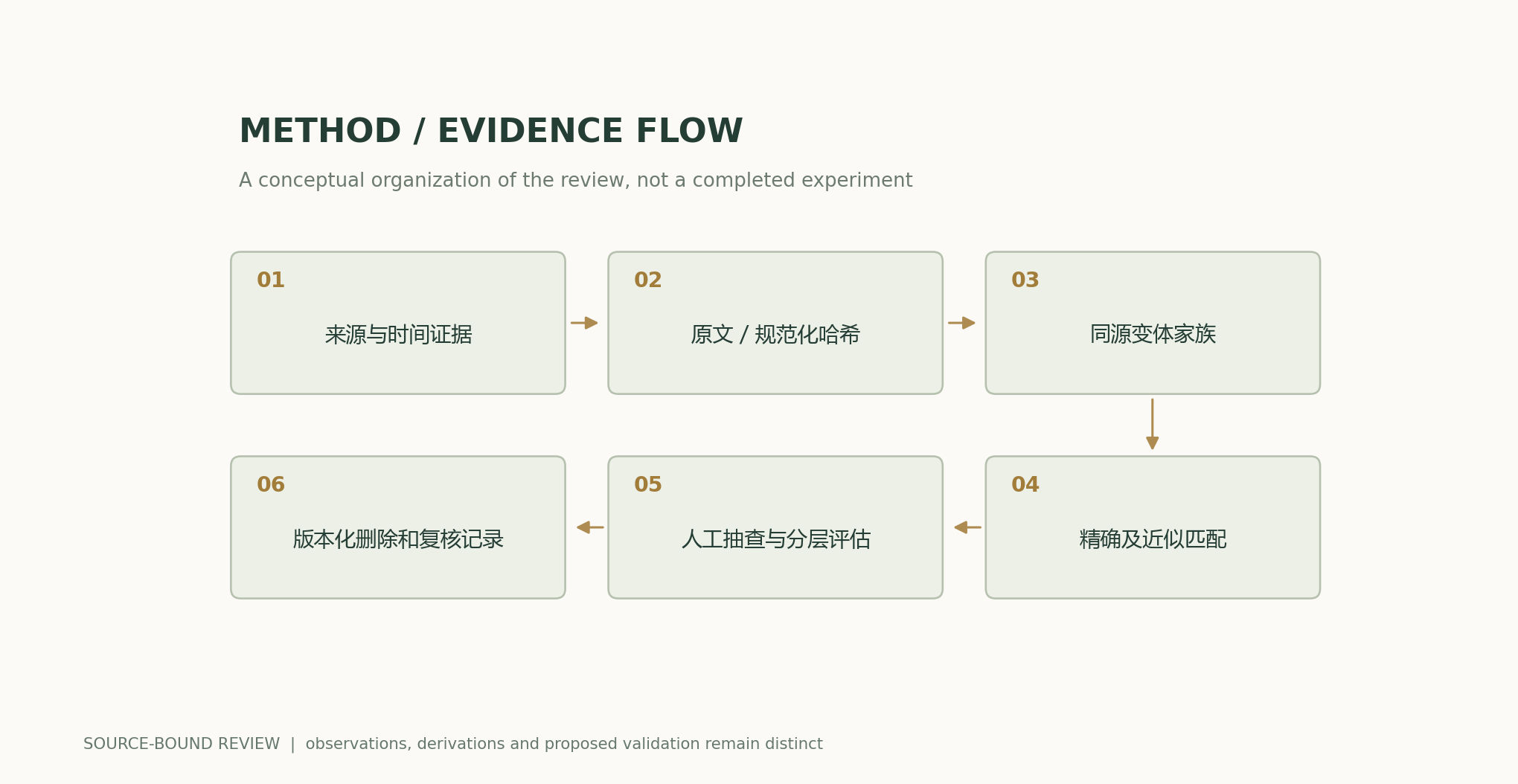
Analytical figures and numerical examples
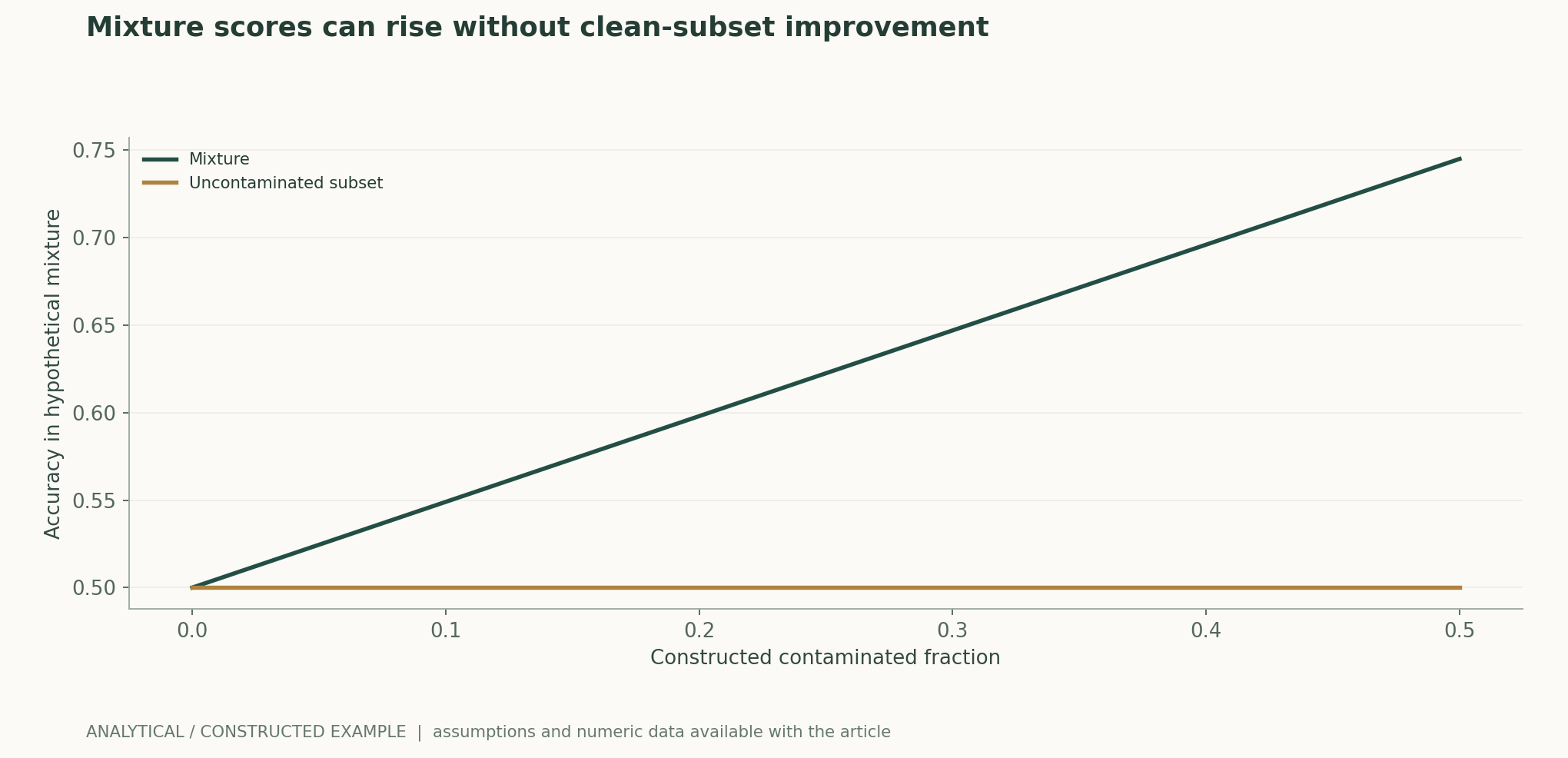
Recomputable worked example
Assume accuracy of 0.99 on the contaminated portion and 0.50 on the remainder. When contamination accounts for 20%, the overall score is 0.598, while performance on uncontaminated samples remains 0.50. This is merely a weighted identity and cannot be used to infer the actual contamination rate.
Method comparison
| Method or judgment | Controlled variables and measurement | Failure conditions and interpretation |
|---|---|---|
| Exact duplicates | Retain normalization rules and hashes | Misses translations and paraphrases |
| Approximate matching | Check precision and recall through stratified sampling | Similar templates may cause erroneous deletion |
| Family-based splitting | Group variants sharing a source before splitting | Randomly splitting individual samples may cause leakage |
| Evaluation stratified by contamination | List scores and sample counts before and after exclusion | No detected match cannot prove the absence of contamination |
Review and experimental plan
- Define the distinct objectives of deduplication and contamination auditing, and fix the detection unit and policies.
- Record original-text hashes, source timing, and normalization and detector versions.
- First split by document, question, or generation family, then perform exact and approximate matching.
- Use stratified sampling on both retained and deleted groups to estimate false positives, false negatives, and uncertainty.
- Report contamination strata and metrics before and after exclusion, and verify using an independent, controlled test set.
- Publish the minimum necessary audit metadata, retain a lawful route for review, and avoid disclosing private material.
Scope and limitations
- The mixture figure does not estimate the actual contamination rate.
- Similarity does not automatically prove answer leakage.
- Detection may both delete samples incorrectly and miss matches.
- No actual private content was extracted.
Mapping primary sources to claims
- Deduplicating Training Data Makes Language Models Better, , , , , , · 2021-07-14Abstract; 原文方法、理论和实验章节见作者原始论文链接
- Documenting Large Webtext Corpora: A Case Study on the Colossal Clean Crawled Corpus, , , , , , , · 2021-04-18Abstract; 原文方法、理论和实验章节见作者原始论文链接
- Holistic Evaluation of Language ModelsLiang et al. · 2022-11-16v2 abstract; seven dimensions and evaluation coverage
Citation and manuscript export
BibTeXRISCSL JSONTXTArticle JSON
Authorship, version, and sources
AI-assisted research review; Codex (AI) wrote the article and performed analytical derivations based on the listed primary literature. This site has no record of independent peer review or original model experiments for this article.
Reader performance revision: previously read pages are also reused when a recent HEAD request returns 200 and the ETag matches. The main text, equations, sources, and scientific-figure data retain the content of the previous version.
The conceptual cover is separate from the scientific figures; scientific figures are calculated from publicly available equations and explicitly stated assumptions, and results from original papers are all attributed.
Authorship, version, and correction history · /guides/data-dedup-contamination/v1/
Sources for the cover and scientific figures · Data, sources, and assumptions · Publication and version history
Source revision: 6251a250b27bb8b449f59b392f81abd355383770