

Abstract
Generative protein design is advancing from “predicting a structure given a sequence” to “proposing sequences and structures given constraints.” Yet successful design must pass through several distinct stages: the backbone satisfies the constraints, the sequence is compatible with the backbone, a sample can be obtained, the conformation is correct, and function is measurable. Focusing on RFdiffusion and ProteinMPNN, this article develops an evaluation framework centered on conditional probabilities and complete attrition records. We derive a design funnel, candidate correlations, and statistical upper bounds for trials with zero failures, showing that self-consistent predictions, sequence recovery, and actual function are not automatically equivalent. The computational figures in this article are budget analyses, not new protein designs or experimental results produced by this site.[1] De novo design of protein structure and function with R[2] Robust deep learning–based protein sequence design usin
English abstract
Protein design is an inverse problem whose success requires a chain from geometric generation to sequence compatibility, expression and measured function. We synthesize RFdiffusion and ProteinMPNN while separating self-consistency from independent validation. A conditional funnel and a correlated-library calculation show why a large number of generated candidates is not the same as many independent experimental opportunities. We propose a budget-matched prospective evaluation with complete attrition accounting and orthogonal functional endpoints.
1. An inverse problem has no single correct answer
Protein function constraints often permit many sequences and conformations. The task of inverse design is not to recover a natural sequence, but to identify candidates within the feasible set that can achieve the objective. RFdiffusion uses backbone denoising under various design conditions, whereas ProteinMPNN generates sequences conditioned on a given backbone; they address adjacent but distinct problems. Consequently, a probability or score at one stage cannot be interpreted as the success rate of the entire design chain. This article recommends first expressing the objective as measurable endpoints and allowable errors, then distinguishing motifs that must be preserved, regions that may vary, and subsequent screening criteria. This prevents the task from being retrospectively rewritten after generation to fit whatever the candidates happen to do well.[1] De novo design of protein structure and function with R[2] Robust deep learning–based protein sequence design usin
2. Generative models learn distributions and conditions, not physical theorems
RFdiffusion adapts a structure prediction network to a denoising task and demonstrates design capabilities including binders and symmetric assemblies. Its conditioning mechanism allows researchers to embed local geometric constraints in generation, but the model remains limited by its training structures and task settings. Satisfying constraints does not guarantee properties of the energy landscape, folding kinetics, or solution behavior. The key methodological issue here is constraint strength: if constraints are too weak, candidates may depart from the functional geometry; if they are too strong, only a narrow family of mutually similar designs may remain. Evaluation should present both constraint errors and the number of design families, rather than showing only the most visually refined individual conformation.[1] De novo design of protein structure and function with R
3. Sequence recovery explains part of model consistency
ProteinMPNN reported relatively high sequence recovery in the original paper's native-backbone tests and evaluated designs through various structural and assembly experiments. Native sequence recovery can measure part of the capacity for conditional modeling, but it is not a sufficient condition for successful new function: many different sequences can form similar backbones, while a change at a single critical site may affect folding or activity. Design evaluations should retain the backbone, conditional sequence distribution, and preserved sites together. If a structure predictor is used for filtering, the training relationship between predictor and generator should also be recorded, to avoid treating agreement arising from the same bias as independent support.[2] Robust deep learning–based protein sequence design usin[1] De novo design of protein structure and function with R
4. Derivation in this article: the success funnel denominator must begin at generation
Let backbone acceptance, sequence acceptance, sample availability, and functional acceptance constitute four successive stages, with each probability conditioned on passing the preceding stages. The full-chain success rate is the product of these conditional probabilities; no additional assumption of marginal independence between stages is required. In the constructed example, the successive values are 0.8, 0.6, 0.5, and 0.2, so 1000 initial candidates yield an expected 48 functional hits. Counting only among the final 240 samples would instead produce a reported rate of 20%, which answers a different question from the 4.8% calculated using the initial candidates. The figure places the two denominators side by side to help readers distinguish screening efficiency from end-to-end yield.作者分析与复核建议 / Author analysis
5. Analysis in this article: file counts cannot substitute for sequence diversity
If a set of candidates shares the same backbone, contact pattern, and major sequence features, their successes and failures may be highly correlated. This article uses the effective sample size for estimating an equicorrelated mean as a budgetary warning: under a constructed correlation coefficient of 0.2, 100 candidates contribute only as much to the precision of the mean as approximately 4.81 independent samples. This formula does not precisely describe binary design success or failure, nor does it directly equate family similarity with a correlation coefficient. It indicates that candidates should be jointly clustered by backbone, sequence, and interface, and that success rates across families should be reported. Diversity should enter the candidate selection objective, rather than merely serve as an additional adjective in the presentation of results.作者分析与复核建议 / Author analysis
6. How to use self-consistency structure filtering
After generation, using a structure predictor to check whether a sequence returns to the target backbone is a valuable, inexpensive filtering step; research related to RFdiffusion and ProteinMPNN combines computational screening with experimental characterization. Its limitation is that the predictor may share structural preferences with the generator and may overlook certain disordered, aggregated, or incorrect oligomeric states. This article therefore advocates labeling self-consistency as a computational evidence field, while recording external structural and functional evidence separately. After thousands of optimization rounds against the same filter, transfer should be tested beyond the candidates subject to the frozen screening rules; high scores obtained after training adaptation cannot be treated as entirely new discoveries.[1] De novo design of protein structure and function with R[2] Robust deep learning–based protein sequence design usin[3] Accurate structure prediction of biomolecular interacti
7. Derivation in this article: intervals are still needed when no failures are observed
Under the assumption of independent and identically distributed trials, if no failures of a given type are observed in n trials, the one-sided 95% upper bound is 1−0.05^(1/n). At n=30, the upper bound remains approximately 9.50%, and at n=300, approximately 0.994%. Thus, “all passed” must be accompanied by the sample size, independence assumptions, and endpoint definition. Family correlations in design libraries further weaken the independence assumption. We recommend reporting results by experimental batch and design family, retaining expression failures, impure samples, and unmeasurable cases, rather than declaring zero failures after deleting them. This derivation addresses statistical accounting only; it does not estimate the failure rate of any published model.作者分析与复核建议 / Author analysis
8. Structural hits and functional hits require different controls
A designed protein may adopt the expected shape yet lack the target function, or it may occupy multiple conformations while still exhibiting a particular function. To understand why a design succeeds, controls should separately challenge geometry and mechanism—for example, by comparing candidates that retain the backbone while altering critical local conditions—and sample state should be recorded independently. Individual studies should also examine selectivity with respect to other targets and reproducibility across batches. This article presents these as requirements for research design, not as results of experiments that have not been performed. Only when controls can distinguish “the model happened to generate a stable protein” from “the model fulfilled the specified function” can the design narrative become a reliable scientific explanation.作者分析与复核建议 / Author analysis
9. A more rigorous budget-matched evaluation
We propose assigning different pipelines the same generation budget and the same subsequent validation budget, with the target set, permitted number of adjustments, and stopping rules fixed in advance. The primary endpoint is the number of independent functional families obtained per unit of experimental budget, supplemented by the success rate calculated from all initial candidates. Comparisons should include a simple baseline and ablations involving backbone changes alone, sequence changes alone, and the complete closed loop, with failure causes recorded hierarchically. If a method improves the final-stage hit rate but substantially increases upstream screening costs, the conclusion should present both costs and outputs, rather than claiming general superiority solely from a high proportion among selected samples.作者分析与复核建议 / Author analysis
Technical supplement A · Coordinate symmetries in structural denoising
Global rotation and translation of protein backbone coordinates do not change its physical identity, so generation must handle these symmetries appropriately. Connecting coordinate noise, local frames, and conditioning motifs allows a model to explore multiple backbones under geometric constraints; fixing certain positions, however, also changes the feasible set. This article recommends applying rigid-body transformations to the same input, checking whether the output distributions preserve the corresponding relationship after inverse transformation, and separating motif error, bond geometry, and global folding. This test validates implementation and representation; it cannot replace external measurements of whether a protein is expressed, soluble, or functional.[1] De novo design of protein structure and function with R
Technical supplement B · Decoding order for conditional sequence probabilities
Given a backbone, the sequence distribution can be factorized into a product of conditional probabilities using different positional orders. With autoregressive decoding, previously selected positions influence later candidates; temperature and repeated sampling change the exploration strategy, not automatically the final experimental distribution. Equivalent positions in symmetric assemblies may be tied, reducing degrees of freedom and changing effective diversity. This article recommends recording decoding order, fixed residues, symmetry ties, temperature, and seeds together, and deduplicating by final sequences and structural families. Publishing only a mean sequence probability cannot explain correlations or functional differences between candidates.[2] Robust deep learning–based protein sequence design usin
Technical supplement C · Information value matters more than continued sampling
If samples from a design family repeatedly prove unobtainable, continued sampling from that family may merely add similar failures. This article proposes targeting unresolved failure mechanisms in the next measurement: for example, first determine whether the limitation concerns backbone stability, sample state, or functional geometry, then decide which stage to change. This approach can be formulated as conditional information gain, rather than simply selecting the highest model score. Evaluation should record how measurements change the distribution of subsequent candidates and compare pure sampling with feedback strategies against preregistered objectives. Without actual feedback experiments, one may propose a design but must not claim that active learning has improved real hit rates.作者分析与复核建议 / Author analysis
Technical supplement D · From within-family success to transfer across targets
Obtaining several similar successful candidates for one target demonstrates that feasible solutions exist in that local design space; transfer to new targets requires effectiveness under different surfaces, geometries, and measurement conditions. This article recommends organizing data with targets at the outer level, design families at the middle level, and candidates at the inner level, reporting variation at all three levels separately. If there are very few targets, the total candidate count cannot justify extremely narrow intervals across targets. Budget matching should also be performed at the target level, preventing one method from investing more only in easier targets. This allows the capability of a design platform to be clearly distinguished from detailed optimization of a single successful case.作者分析与复核建议 / Author analysis
10. What should verifiable design outputs deliver?
The most valuable public package does not merely provide the best structure; it connects target specifications, generation conditions, candidate families, screening ledgers, sample identities, and functional endpoints. The equations and figures in this article express design efficiency as inspectable denominator relationships; experimental results from the original papers remain attributable to the original teams. Subsequent reproductions should retain differences from the original settings and allow negative results to be attached to precise candidates and versions. In this way, a design platform can move from repeatedly presenting successful examples toward an engineering and scientific system that accumulates knowledge: readers know what has been measured and what question the next most informative experiment should answer.作者分析与复核建议 / Author analysis
Core equations and derivations
(1) Pipeline factorization for backbone x, sequence s, and constraints c; this is an organizational form for modeling, not a guarantee of physical or functional validity.
LaTeX
p(x,s\mid c)=p_\theta(x\mid c)\,p_\phi(s\mid x,c)(2) A four-stage conditional chain corresponding to backbone, sequence, sample, and functional acceptance; marginal independence is not required.
LaTeX
P(F)=P(B)P(S\mid B)P(E\mid S,B)P(F\mid E,S,B)(3) Effective sample size for a sample mean with equal variances and equal correlations, used as an analytical warning for correlated design libraries, not as a fit to actual successes and failures.
LaTeX
n_{\mathrm{eff}}=\frac{n}{1+(n-1)\rho}(4) The exact one-sided 95% upper bound for zero failures in n independent and identically distributed trials; it cannot be applied directly to correlated samples.
LaTeX
p_{\mathrm{failure,upper}}=1-0.05^{1/n}Methods and evidence workflow
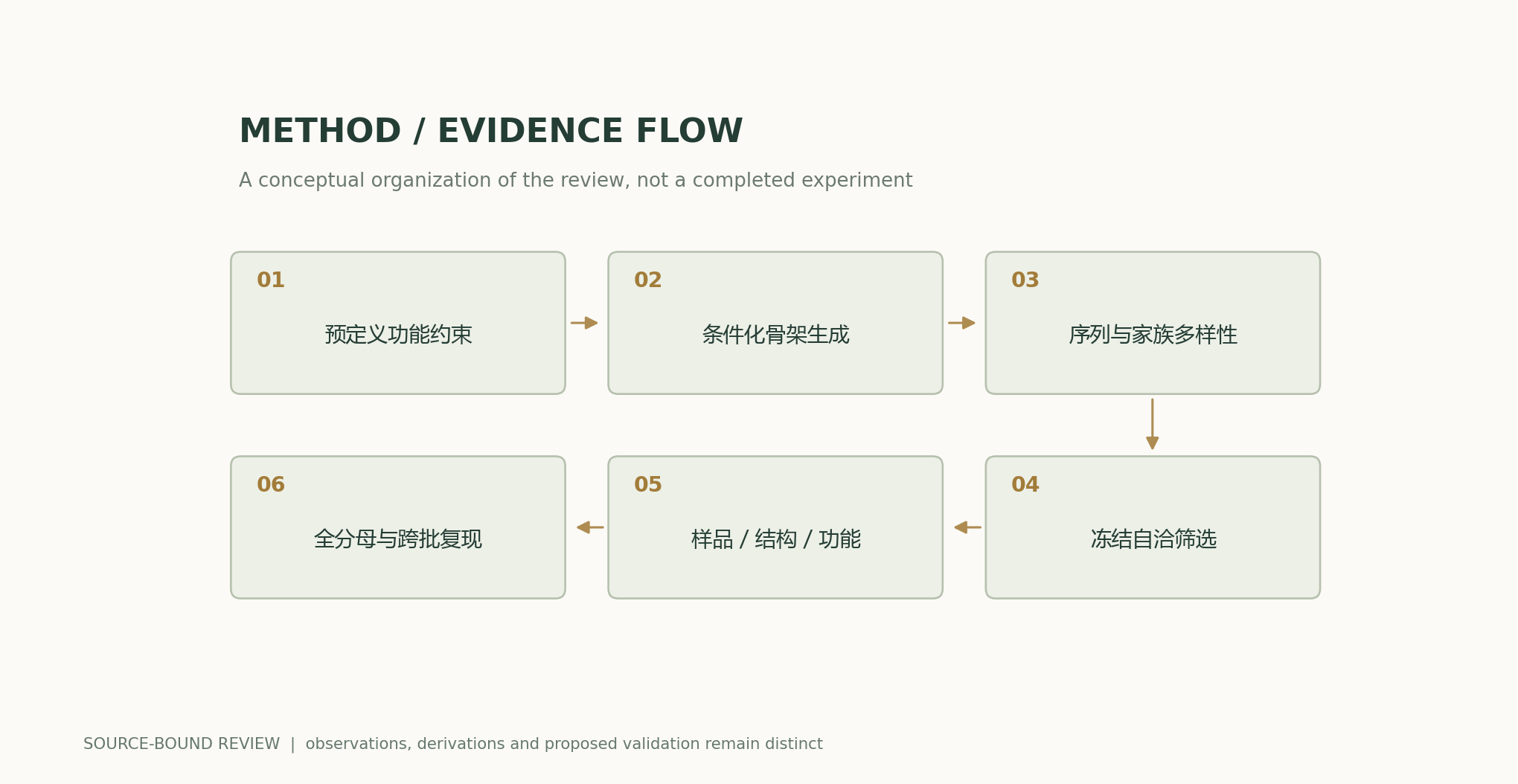
Analytical figures and numerical examples
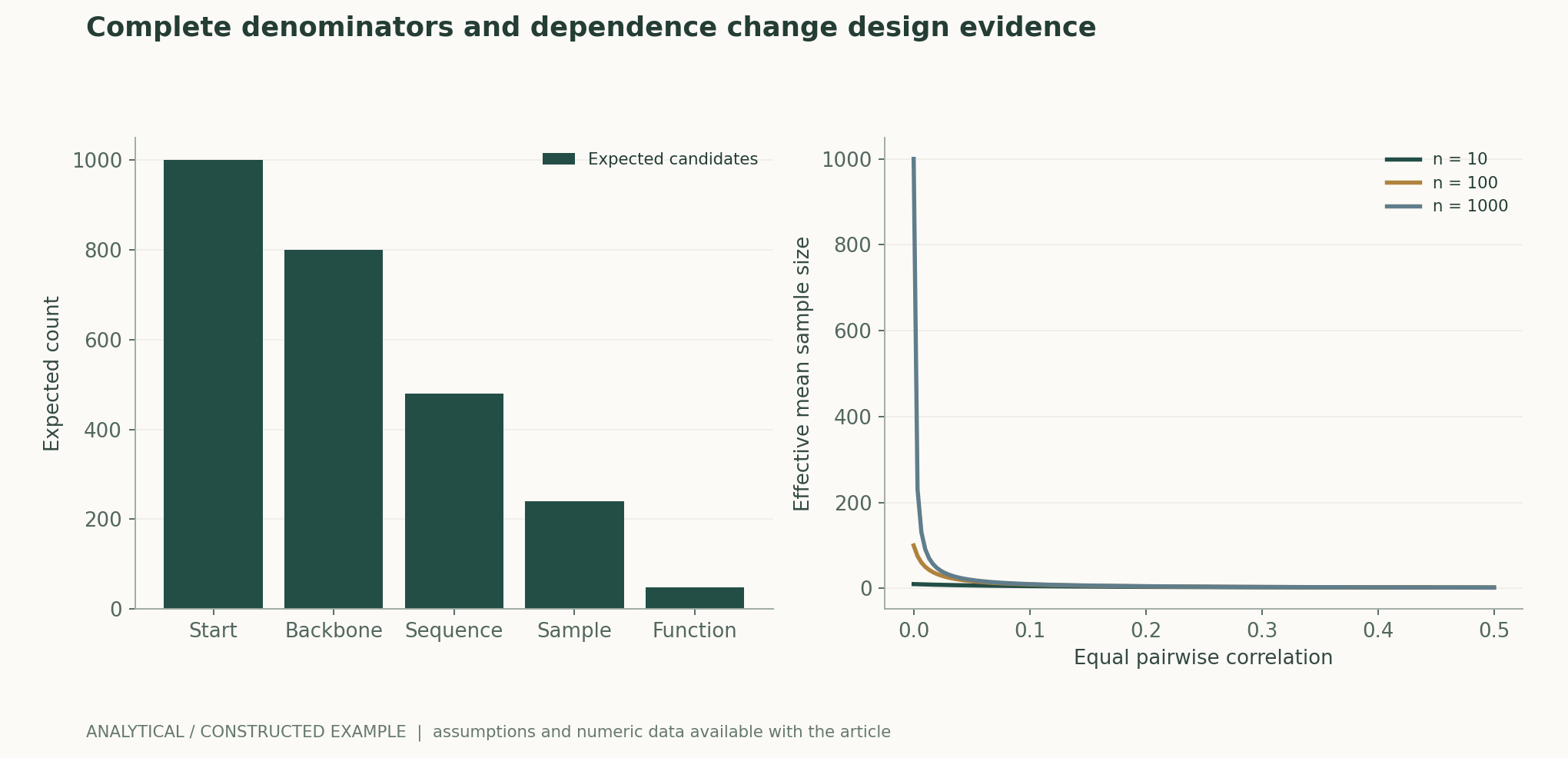
Recomputable worked example
1000×0.8×0.6×0.5×0.2=48, giving 4.8% with the initial denominator and 20% with the final-sample denominator; 100 equicorrelated samples at rho=0.2 have an effective sample size of approximately 4.80769.
Method comparison
| Delivery stage | Measurable evidence | Failures and denominators to retain |
|---|---|---|
| Constrained backbone | Geometric error and feasibility | All generated and invalid backbones |
| Conditional sequence | Fixed positions and sequence distribution | Candidates corresponding to all backbones |
| Self-consistent prediction | Return to the target structure and interface scoring | Predictor version and screening attrition |
| Sample acquisition | Expression, purity, and identity | Unobtainable and unmeasurable cases |
| Functional hit | Predefined endpoints and controls | All samples submitted for testing and independent families |
| Generalization and cost | New targets, cross-batch evaluation, and budget | Number of tuning attempts, human intervention, and time spent |
Verification and experimental plan
- Preregister objectives, allowable geometric variation, primary functional endpoints, and an upper limit on candidate screening.
- Fix the model and conditional generation configuration, and deliver backbones, sequences, seeds, and summaries.
- Cluster candidates by sequence, backbone, and contact geometry, recording all members of each family.
- Match generation and independent validation budgets across methods, and retain a simple baseline.
- Freeze the self-consistency filter and thresholds, recording the reason for attrition at each step.
- Include both unobtainable and unmeasurable samples in the corresponding denominators; do not silently delete them.
- Confirm structural and functional endpoints separately, and provide intervals by batch and family.
- Disclose failures and differences in reproduction; register unfinished validation only as planned work, not as a functional design achievement.
Scope and limitations
- No models were run and no new proteins were prepared.
- The funnel probabilities are constructed inputs and do not represent RFdiffusion's hit rate.
- The effective sample size formula applies to analyses of equicorrelated means; it is not a law of sequence similarity.
- The zero-failure upper bound requires independent and identically distributed trials and a fixed endpoint.
- Structure, expression, and function remain limited by the specific system and measurement conditions.
Evidence from the original studies and its scope
| Original study results | Scope | Source and location |
|---|---|---|
| Demonstrates multiple classes of conditional protein design and experimentally characterizes designed structures and functions. | The experiments support only the targets, samples, and conditions tested in the original study. | De novo design of protein structure and function with RFdiffusionAbstract; design tasks and characterization |
| Native-backbone sequence recovery and diverse experimental tests of designs. | Sequence recovery is not a sufficient condition for new function. | Robust deep learning–based protein sequence design using ProteinMPNNResults and Conclusion |
Research questions worth testing
- Under a fixed budget, does diversity across families increase the yield of independent functional families?
- Can the calibration of computational self-consistency on new targets transfer across generators?
- Which failure stages most warrant additional measurement rather than further sampling?
Mapping primary sources to claims
- De novo design of protein structure and function with RFdiffusionWatson et al. · 2023-07-11Abstract; conditional backbone generation, experimental characterization and limitations.
- Robust deep learning–based protein sequence design using ProteinMPNNDauparas et al. · 2022-09-15Abstract and Results; native sequence recovery is distinct from folding and functional validation.
- Accurate structure prediction of biomolecular interactions with AlphaFold 3Abramson et al. · 2024-05-08Nature 2024; diffusion module and limitations
Citation and manuscript export
BibTeXRISCSL JSONTXTArticle JSON
Author, version, and sources
A sourced research review and original analysis written by Codex (AI). Experiments in the original papers belong to the original research teams; calculations in this article test only the listed equations and explicit assumptions. This site does not yet have records of independent peer review of this article or of original models, clinical experiments, or physical experiments for it.
First published: in-depth feature on AI and scientific discovery; preserving section-level sources and the boundaries between original research evidence and the author's analysis.
The conceptual cover was generated by ImageGen. Scientific figures were drawn using the accompanying code and numerical files; captions specify the assumptions and measurement bases item by item.
Sources of the cover and scientific figures · Data, sources, and assumptions · Python · Recomputable code · Publication and version history
Source revision: b7b48f7205d705b2a3d3e8de0be5e1b458e4869c