
Abstract
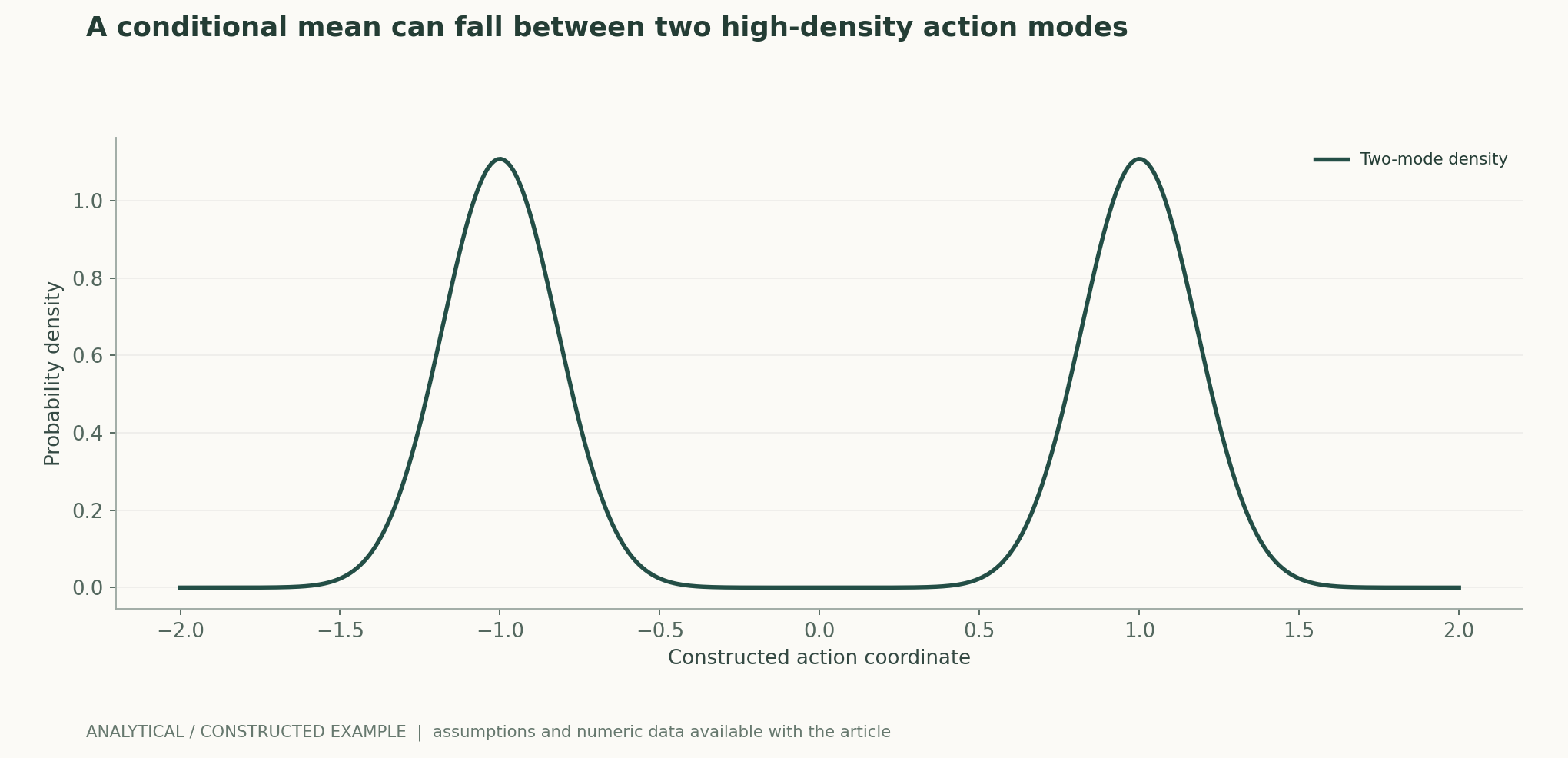
Robot demonstrations may contain multiple reasonable strategies, and directly averaging actions may yield an action in a region with very low demonstration probability. Diffusion policies model action sequences through conditional denoising, but closed-loop success also depends on perception, latency, the execution window, and changes in the state distribution. This article compares the interfaces of generative policies, cross-task data, and vision-language-action approaches, and proposes staged acceptance testing from offline evaluation to controlled physical testing. The figure shows a constructed bimodal distribution and does not correspond to real robot trajectories.[1] Diffusion Policy: Visuomotor Policy Learning via Action[2] Learning Fine-Grained Bimanual Manipulation with Low-Co[3] RT-2: Vision-Language-Action Models Transfer Web Knowle
English abstract
Diffusion policies model conditional action sequences rather than a single mean action. We use a declared bimodal density to explain why averaging can produce a low-density action, then analyze receding-horizon execution and latency. The figure is not robot trajectory data. Offline prediction quality, closed-loop success and safety require separate validation.
1. Multimodal actions cannot be arbitrarily replaced by their mean
The same observation may permit moving around either the left or the right side of an object. Both actions are reasonable, yet their mean may point toward an obstacle in the middle. This example illustrates that the conditional mean from squared-error regression differs from an executable policy, but not every task requires a multimodal model. Diffusion policies generate action sequences through conditional denoising and can represent multiple candidate modes; whether they actually cover the demonstrations and generate stable actions still requires checking action units, limits, coordinate frames, and the training distribution.[1] Diffusion Policy: Visuomotor Policy Learning via Action
2. Sequence generation and closed-loop replanning work together
A policy can predict a window of actions, execute only part of it, and then perceive and plan again. Longer windows reduce the frequency of recomputation but may leave execution dependent on outdated observations for longer; shorter windows respond faster but increase inference and communication demands. Both the number of denoising steps and the output length affect latency. Comparisons should hold the perception frequency, execution window, and controller interface fixed; real-world task success cannot be inferred solely from offline action error.[1] Diffusion Policy: Visuomotor Policy Learning via Action
3. Pretraining and cross-task data change the scope of applicability
RT-1 studies the scaling of real-world robot task data and sequence modeling, while RT-2 connects vision-language knowledge with action representations. These works offer different representation and training pathways, but their data, robots, action discretization, and task definitions differ, so they cannot be ranked directly by the numbers in their abstracts. Before transfer to a new platform, action semantics, camera calibration, workspace, and training coverage should be specified; language comprehension cannot substitute for physical dynamics and execution reliability.[2] Learning Fine-Grained Bimanual Manipulation with Low-Co[3] RT-2: Vision-Language-Action Models Transfer Web Knowle
4. The latency budget is part of the policy
The total latency of sensing, preprocessing, model inference, communication, and execution preparation must be compatible with the control period. Even when average latency meets requirements, tail latency may still cause instability or safety risks. Timestamp alignment, stale observations, dropped frames, and behavior after timeouts should be measured, and execution should be constrained by independent limit and stop mechanisms. No robot was connected for this article; any real-world testing should first take place in a lawful, controlled environment, and generated actions must not be treated directly as safe commands.[1] Diffusion Policy: Visuomotor Policy Learning via Action[2] Learning Fine-Grained Bimanual Manipulation with Low-Co
5. Offline scores and closed-loop success require different data
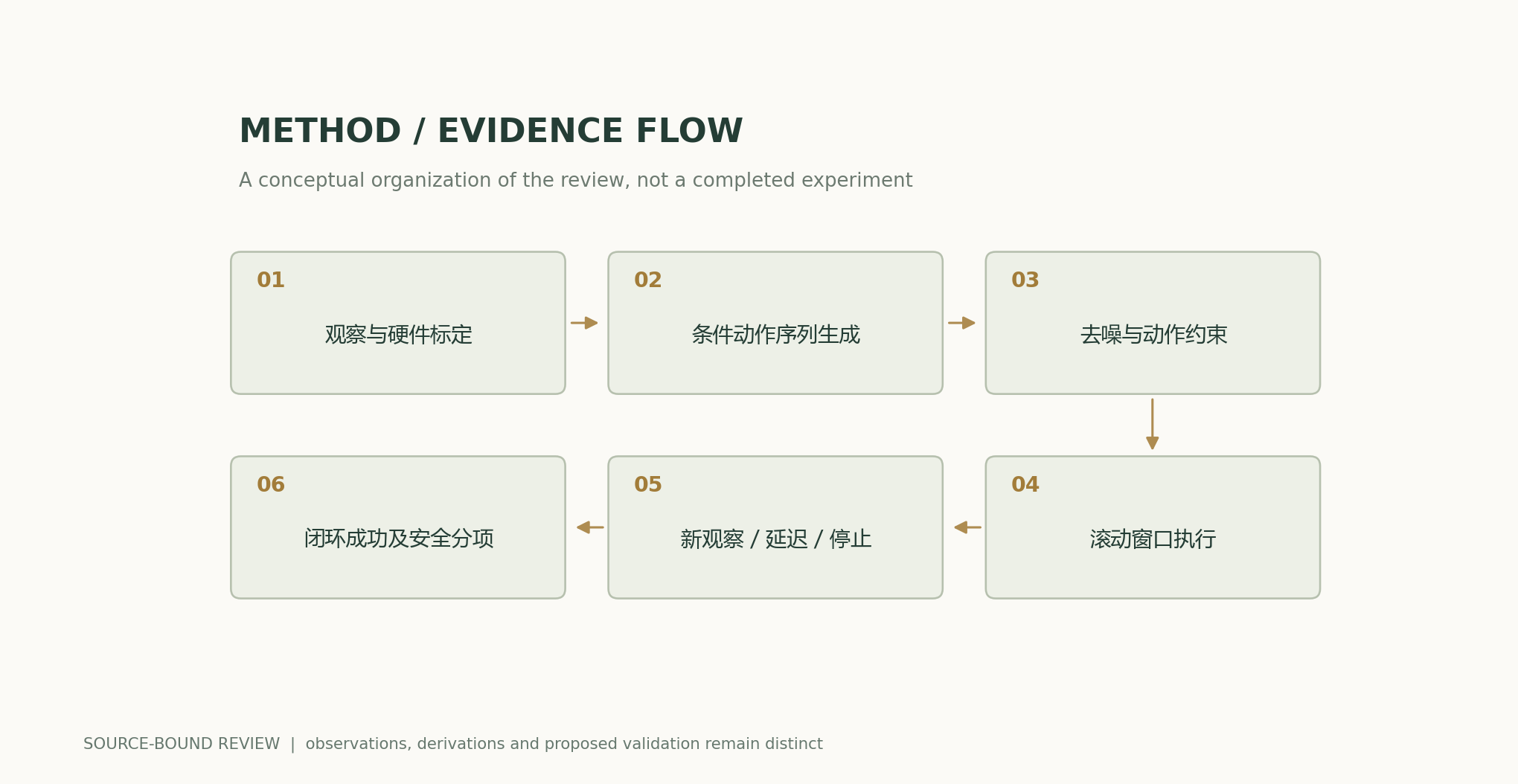
Offline validation examines only action predictions near the demonstrations, whereas closed-loop errors alter subsequent states, causing the model to encounter observations that are less common in training. Acceptance testing should first check the action interface and simulation, then test recovery under controlled perturbations, recording separate metrics such as task success, collisions, takeovers, and timeouts. Repeated trials must cover object positions, lighting, and initial states, and failures must not be removed before statistical analysis. Safety metrics and task metrics must be reported separately.[1] Diffusion Policy: Visuomotor Policy Learning via Action[3] RT-2: Vision-Language-Action Models Transfer Web Knowle
6. Reproduction records should include hardware and operating conditions
Retain records of the robot, end effector, firmware, cameras, calibration, control frequency, and data and model versions. Environmental variation in real-world trials may exceed differences between algorithms, making randomized order, the same initial distribution, and sufficient repetitions necessary. Those reproducing the work should specify which conditions match and which differ, and register unsuccessful cases. This article explains only multimodality and control constraints; it has not conducted robot experiments and does not claim a physical-world success rate.[1] Diffusion Policy: Visuomotor Policy Learning via Action[2] Learning Fine-Grained Bimanual Manipulation with Low-Co[3] RT-2: Vision-Language-Action Models Transfer Web Knowle
Core equations and derivations
(1) Conditional distribution over action sequences; the observation history, action parameterization, and execution window must be specified.
LaTeX
\pi_\theta(a_{t:t+H}\mid o_{\le t})(2) Schematic action-denoising objective; it is not equivalent to collision rate, stability, or real-world task success rate.
LaTeX
\mathcal L=\mathbb E\|\epsilon-\epsilon_\theta(a^{(s)},s,o)\|_2^2(3) Tail latency and timestamps must be considered; meeting the average budget does not constitute proof of control safety.
LaTeX
\tau_{\mathrm{sense}}+\tau_{\mathrm{infer}}+\tau_{\mathrm{comm}}+\tau_{\mathrm{prepare}}\le T_{\mathrm{budget}}Method and evidence workflow
Analytical figures and numerical examples
Recomputable worked example
The mean of the symmetric bimodal distribution is 0, but the density near 0 is much lower than at ±1. This illustrates that the mean may not represent a feasible mode; it does not prove that diffusion policies automatically satisfy any robot constraints.
Method comparison
| Method or assessment | Controlled variables and measurements | Failure conditions and explanations |
|---|---|---|
| Multimodal policy | Check action modes, units, and constraints | The conditional mean may lack support from executable actions |
| Receding-horizon execution | Fix the prediction and execution windows | Long windows entail a trade-off with feedback timeliness |
| Cross-task transfer | Check the platform, calibration, and data coverage | Language ability does not equal physical reliability |
| Physical acceptance testing | List success, takeovers, collisions, and timeouts separately | Offline error cannot replace closed-loop testing |
Verification and experimental plan
- Freeze the hardware, calibration, coordinate frames, action units, and control-interface version.
- Split demonstrations by task and environment to prevent adjacent trajectory segments from spanning training and test sets.
- First check output ranges, limits, stopping, and simulation, then proceed to controlled physical trials.
- Fix the replanning and execution windows, and measure tail latency and stale observations across all stages.
- Randomize initial states and repeat trials, independently recording success, collisions, takeovers, timeouts, and recovery.
- Disclose environmental differences and failures; do not substitute selected videos for complete trial statistics.
Scope and limitations
- The bimodal density is not robot trajectory data.
- No physical robot experiments were conducted.
- Action-distribution quality does not prove safety.
- Cross-platform transfer requires rechecking interfaces.
Primary sources and corresponding claims
- Diffusion Policy: Visuomotor Policy Learning via Action Diffusion, , , , , , , · 2023-03-07Abstract; 原文方法、理论和实验章节见作者原始论文链接
- Learning Fine-Grained Bimanual Manipulation with Low-Cost Hardware, , , · 2023-04-23Abstract; 原文方法、理论和实验章节见作者原始论文链接
- RT-2: Vision-Language-Action Models Transfer Web Knowledge to Robotic Control, , , , , , , , , , , , , , , , , , , , , , , , , , , , , , , , , , , , , , , , , , , , , , , , , , , , , -------------------------------------------------------------------------------- · 2023-07-28Abstract; 原文方法、理论和实验章节见作者原始论文链接
Citation and article export
BibTeXRISCSL JSONTXTArticle JSON
Author, version, and sources
AI-assisted research review; Codex (AI) wrote the article and performed analytical derivations based on the listed primary literature. This site has no record of independent peer review or original model experiments for this article.
Reader performance revision: previously read pages are also reused when a recent HEAD request returns 200 and the ETag matches. The main text, equations, sources, and scientific-figure data retain the content of the previous version.
The conceptual cover is separate from the scientific illustrations; scientific figures are computed from publicly available equations and explicitly stated assumptions, and all results from the original papers are attributed.
Author, version, and correction history · /guides/robotics-diffusion-policy/v1/
Sources of the cover and scientific figures · Data, sources, and assumptions · Publication and version history
Source revision: 6251a250b27bb8b449f59b392f81abd355383770